



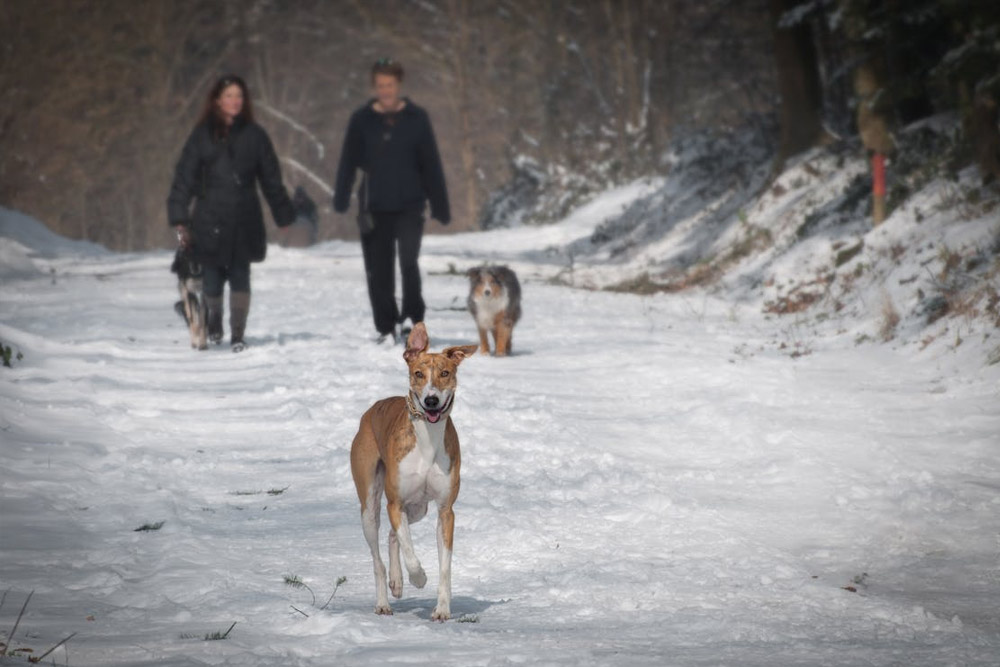
How to Train a Dog for Off-Leash Walking
Off-leash walking is one of those skills that looks effortless when you see it done well. A dog moving calmly beside their owner, no leash, no tension, just two beings who trust each other completely. If you have a dog that pulls, bolts, or completely ignores you the second the leash comes off, that kind of relationship can feel a long way off.
It isn’t. But getting there takes real work, done in the right order.
This guide covers what off-leash obedience actually requires, how to build it systematically, and what tends to go wrong when owners try to rush it.
What Does Off-Leash Training Actually Involve?
Off-leash walking isn’t a trick. It’s the end result of a dog that has solid obedience foundations, a reliable recall, a strong bond with their handler, and enough real-world experience to hold their behavior together when there are distractions around.
A lot of owners think of it as a leash problem, as in, “my dog would be fine if I could just take the leash off.” The opposite is usually true. If a dog doesn’t walk nicely on leash, they won’t walk nicely off it. The leash is a communication tool and a safety net. Off-leash work removes both of those things at once, which is why the underlying obedience has to be genuinely solid before you get there.
The Foundation You Need Before Going Off-Leash
1. Reliable On-Leash Obedience First
Your dog should be able to walk on a loose leash, hold a sit and a down with duration and mild distractions, and come when called in a variety of environments before off-leash work begins. These aren’t prerequisites that can be rushed through. They’re the actual skills that off-leash walking is built on.
If any of these are shaky, that’s where to focus your energy first. A dog that bolts when called in the backyard is not ready to be off-leash around other dogs and people in a park.
2. A Recall That Works Every Single Time
Recall (the command to come when called) is the most critical piece of the off-leash puzzle. It’s also the one that tends to be the most undertrained, because owners practice it when it’s easy (calling their dog from three feet away in the living room) and not when it’s hard (calling their dog away from something exciting in a new environment).
A strong recall means your dog turns toward you immediately when you call them, regardless of what they’re doing or what’s nearby. Building this takes time, repetition across many environments, and consistently making coming to you the best possible choice your dog can make in that moment.
Never call your dog and then do something unpleasant immediately after, like ending a play session abruptly or putting them in the car when they’d rather keep running. Every time your dog comes to you and something good happens, the recall gets stronger. Every time they come to you and something they dislike happens, you’re chipping away at it.
3. The “Place” Command as an Anchor
The Place command, where your dog goes to a designated bed or mat and holds their position, is one of the most underrated tools in off-leash training. It teaches a dog to stay put with duration and self-control, even when the environment is interesting. That same self-control transfers directly to off-leash walking.
A dog that can hold Place for 10 minutes in a busy environment has already demonstrated the ability to manage impulses and look to you for release. That’s exactly what you need from a dog moving off-leash beside you.
How to Build Off-Leash Walking Step by Step
Step 1: Establish Solid Leash Behavior
Start with a dog that walks calmly at your side on leash without pulling, lunging, or constantly scanning for distractions. Your dog should be checking in with you regularly, not just tolerating you being at the other end of the leash.
Use a consistent position. Most handlers work with the dog on their left side, but the side matters less than the consistency. Your dog needs to know where they’re supposed to be.
Step 2: Work on a Long Line
A long line, typically a 15 to 30 foot lead, is the bridge between leash and off-leash. It gives your dog more freedom of movement while keeping you connected. It also lets you enforce recall if your dog doesn’t respond the first time, which is critical.
If your dog can ignore a recall and nothing happens as a result, you’ve just taught them that coming when called is optional. The long line removes that option without removing the freedom. Work on recall, changes of direction, and position work with the long line before moving to dragging it, and then to dropping it entirely.
Step 3: Train in Low-Distraction Environments First
Start off-leash work in a fenced area with minimal distractions, like your backyard, a quiet training field, an enclosed space where your dog can’t disappear. Add distractions gradually: another person standing nearby, a ball on the ground, a dog in the distance. Only increase the difficulty when your dog is succeeding reliably at the current level.
This sounds obvious, but it’s the step most owners skip. They go from “pretty good in the backyard” to “off-leash at the dog park” and then wonder why their dog fell apart. The jump in difficulty is enormous. The training didn’t prepare them for it.
Step 4: Proof the Behavior in Real Environments
Proofing means practicing the behavior in enough different environments that your dog generalizes it — that they understand “walk with me” means walk with me everywhere, not just on the trail behind your house.
Take your dog to different parks, different neighborhoods, different surfaces. Practice near other dogs, near cyclists, near children. Each new environment is a test. If your dog passes, move on. If they struggle, you’ve found the gap in their training, and that’s exactly the information you need.
Denver has no shortage of great places to do this work: walking trails, open space areas, neighborhood parks. Use them, but do it with intention. Off-leash in an unfamiliar environment isn’t a treat. It’s a training session.
Common Off-Leash Training Mistakes
- Going off-leash too soon is the most common and most costly mistake. Owners see good behavior on leash and assume off-leash will follow naturally. It won’t. The leash was doing a lot of work. When you remove it, you find out what the training is actually built on.
- Practicing only in comfortable environments creates a dog that’s reliable at home and nowhere else. Your dog needs to practice in places that are actually difficult for them. Otherwise you’re not building real obedience; you’re just confirming that your dog behaves when nothing is testing them.
- Inconsistent recalls teach dogs that coming when called is negotiable. If your dog doesn’t come and you repeat the command, wait, and eventually give up, you’ve just practiced a recall that doesn’t work. Be prepared to follow through every single time, which is why the long line is so useful in the training phase.
- Calling your dog to end something fun poisons the recall over time. If every time you call your dog it means the walk is over or the play session is stopping, a smart dog will figure that out and start hesitating. Call your dog frequently during off-leash time for no reason other than to give them a reward and send them back to play.
How Long Does Off-Leash Training Take?
There’s no fixed timeline, and anyone who tells you “four weeks and your dog will be fully off-leash reliable” without knowing your dog is guessing. A young dog with no obedience history is in a very different place than an 18-month-old dog that has been through a basic obedience program and has a solid recall already.
What we can say from experience is that skipping steps always takes longer in the end than doing them in the right order. Owners who try to rush to off-leash and hit problems spend more total time fixing those problems than owners who built the foundation properly to begin with.
When Does It Make Sense to Get Professional Help?
For some dogs, structured professional training is the fastest and most reliable path to off-leash reliability. Dogs with high prey drive, significant reactivity, or a history of bolting present real safety risks if the off-leash work isn’t handled carefully. A dog that has practiced ignoring its owner for a year or more has deeply ingrained habits that take more than backyard training sessions to change.
Our Canine Immersion board and train program in Denver is specifically designed to build the kind of obedience that holds up in the real world. Dogs in the program train across a wide range of environments — parks, stores, neighborhoods — with consistent professional guidance every day. The off-leash work that comes out of that experience is genuinely different from what most owners can build in weekly sessions.
If you’ve been trying to get reliable off-leash behavior and not getting there, it’s worth having a conversation about whether a more structured approach makes sense for your dog.
Frequently Asked Questions About Off-Leash Dog Training
At what age can you start off-leash training a dog?
You can begin building the foundations — recall, leash manners, Place, basic obedience — from as early as 8 weeks old. Formal off-leash work in open environments is typically introduced once those foundations are solid, which for most dogs is somewhere between 6 months and a year, depending on the individual dog’s progress.
How do I get my dog to walk beside me off-leash?
Start with reliable heel or loose-leash walking on leash. Then transfer to a long line, practicing the same position with added freedom. Introduce the e-collar as a communication tool with professional guidance. Gradually reduce the connection between you and your dog as the behavior becomes consistent. Proof in multiple environments before going fully off-leash in open spaces.
What is the best command for off-leash recall?
Most trainers use “come” or “here” as the recall cue. The specific word matters less than the training behind it. What makes a recall reliable is consistent positive reinforcement when the dog responds, follow-through when they don’t, and practice across many environments and distraction levels.
Is an e-collar necessary for off-leash training?
Not in every case, but for many dogs — especially those with high drive, a history of ignoring commands, or significant distractions in their environment — an e-collar provides a reliable communication channel at distance that is very difficult to replicate otherwise. It needs to be introduced correctly by someone who knows how to use it.
My dog is good off-leash at home but ignores me in public. Why?
This is a training gap, not a disobedience problem. Your dog has learned to respond in familiar, low-distraction environments. The behavior hasn’t been proofed in more demanding situations. The solution is systematic exposure to increasingly difficult environments, with consequences for ignoring commands at each level.
Is it safe to let a dog off-leash in Denver?
Denver has leash laws in city parks and many public areas, so off-leash exercise typically happens in designated off-leash areas, private land, or trails that allow it. Safety is always about the individual dog’s training and reliability, not just the location. A dog with a solid recall and off-leash obedience can be safe in appropriate environments. A dog without those foundations isn’t ready, regardless of where you are.
How do I stop my dog from running away when off-leash?
A dog that bolts when off-leash has either a weak recall or a strong environmental pull (or both) that hasn’t been addressed in training. Don’t put the dog in situations where bolting is possible until the recall is genuinely solid on a long line. Practice recall with increasingly exciting distractions while you still have a safety net.
Can any breed be trained for off-leash walking?
Most breeds can reach a functional level of off-leash reliability with appropriate training, but the difficulty varies significantly. Breeds with strong independent instincts or high prey drive — Huskies, sight hounds, some terriers — require more thorough training and, in some cases, may never be fully reliable in all environments. Knowing your breed’s tendencies helps you set realistic expectations.
What’s the difference between off-leash training and letting your dog run free?
Off-leash training means your dog moves freely but remains responsive to your commands, checks in regularly, and comes when called every time. Letting your dog run free without that foundation in place isn’t off-leash training. It’s practicing ignoring you while hoping nothing goes wrong.
Where can I get help with off-leash training in Denver?
American Canine Academy has been offering professional dog training in Denver since 2005. Our Canine Immersion program specifically builds real-world off-leash obedience, and we regularly take dogs off-site to parks and public areas as part of that training. Schedule a free consultation to talk through what your dog needs.
COMMENTS